
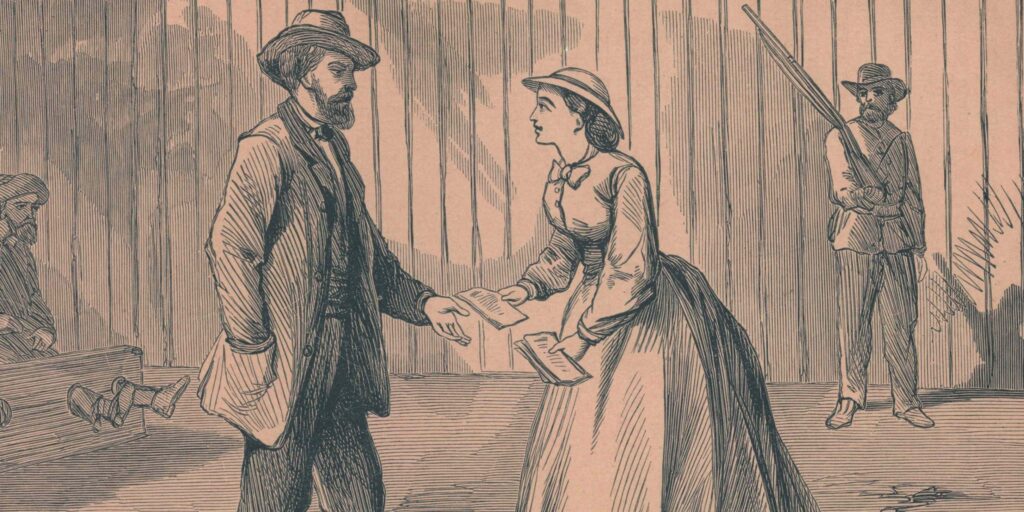
When Americans think of the Civil War, they often picture grand armies, decisive battles, and famous generals. Less visible—but no less critical—was the hidden war fought in shadows. Intelligence gathering, counterintelligence, covert communications, and deception all played vital roles in shaping the conflict. The Civil War marked a turning point in American espionage, laying foundations for the nation’s modern intelligence practices.
For the Order of Cloak and Dagger, the Civil War represents a unique chapter in the evolution of American spying: a moment when espionage shifted from ad hoc efforts to more organized—and sometimes professional—operations.
The Birth of Organized American Intelligence
Before the Civil War, intelligence work in the United States was largely informal, relying on personal networks and individual initiative. The outbreak of war forced both the Union and the Confederacy to develop more systematic approaches to gathering information.
On the Union side, Allan Pinkerton, founder of the Pinkerton National Detective Agency, emerged as one of the most influential figures in early American intelligence. Appointed head of Union intelligence early in the war, Pinkerton organized spy networks, interrogated prisoners, and conducted counterintelligence operations to protect President Abraham Lincoln. Although some of his threat assessments were later criticized as overly cautious, Pinkerton’s work established key principles of intelligence collection and analysis.
The Confederacy, with fewer resources, relied heavily on daring individuals and informal networks—often proving remarkably effective.
Women at the Heart of Civil War Espionage
The Civil War saw unprecedented participation by women in intelligence work. Social expectations often rendered women “invisible” to military authorities, allowing them to gather information with relative freedom.
Belle Boyd, one of the Confederacy’s most famous spies, used charm, audacity, and keen observation to pass Union troop movements to Confederate commanders. Arrested multiple times, she became a symbol of Southern espionage daring.
In stark contrast, Elizabeth Van Lew, a wealthy Virginian loyal to the Union, ran one of the war’s most sophisticated spy rings from Richmond—the Confederate capital itself. Pretending to be mentally unstable to avoid suspicion, Van Lew coordinated intelligence networks, assisted Union prisoners of war, and transmitted critical information to Union generals. Her work was so effective that Ulysses S. Grant later credited her as invaluable to the Union cause.
These women demonstrated that espionage depended as much on psychological insight and social engineering as on secrecy.
Codes, Ciphers, and Covert Communication
The Civil War accelerated the use of coded messages, invisible ink, dead drops, and cipher systems. Both sides experimented with encryption to protect sensitive information, though many methods were crude by modern standards.
Union and Confederate intelligence officers used cipher disks, numeric substitution codes, and hidden messages sewn into clothing or concealed within everyday objects. Telegraph lines—an emerging technology—became both a vital intelligence asset and a vulnerability, leading to early forms of signals intelligence and wiretapping.
Spies, Scouts, and Double Agents
Not all intelligence operatives fit the classic image of the secret spy. Scouts gathered battlefield intelligence, couriers carried sensitive messages across enemy lines, and double agents manipulated both sides.
Perhaps most famously, Harriet Tubman—already renowned for her work on the Underground Railroad—served the Union as a scout and intelligence operative. She helped gather information behind Confederate lines and assisted in planning operations such as the Combahee River Raid, which liberated hundreds of enslaved people.
Legacy of Civil War Espionage
Civil War espionage was often chaotic, dangerous, and deeply personal. Spies faced imprisonment, execution, or public disgrace if discovered. Yet their efforts demonstrated the growing importance of intelligence in warfare.
The lessons learned—from organizing networks to managing sources and protecting communications—would influence American intelligence practices well into the 20th century. Many of the techniques pioneered during the Civil War echo those used by later intelligence services, including during the World Wars and the Cold War.
The Hidden Heros
For members of the Order of Cloak and Dagger, the spies of the Civil War stand as a reminder that America’s intelligence tradition did not begin in the 20th century. It was forged much earlier, by men and women willing to operate in secrecy, deception, and personal risk for a cause they believed in.
Their stories remind us that history is not only shaped on the battlefield—but also in whispers, coded messages, and the courage of those who worked unseen.